Most UAP reports are observational — a person, a phone camera, a square of dark sky. The 2004 Nimitz incident is rare in the field because the data came from a five-billion-dollar carrier strike group, three independent radar systems, and two pilots flying fighters that cost more than most U.S. towns. That's why two decades later it still anchors the conversation.
What actually happened
On November 14, 2004, the USS Princeton — an Aegis-class cruiser screening the Carrier Strike Group ELEVEN around the USS Nimitz — had been tracking unidentified objects intermittently for two weeks. Sensor operators saw the objects appear at 80,000 feet, drop to near sea level in roughly a second, hover, then climb back. The behavior was so consistent and so impossible that the Princeton's radar team initially assumed equipment failure. After replacing components, the tracks continued.
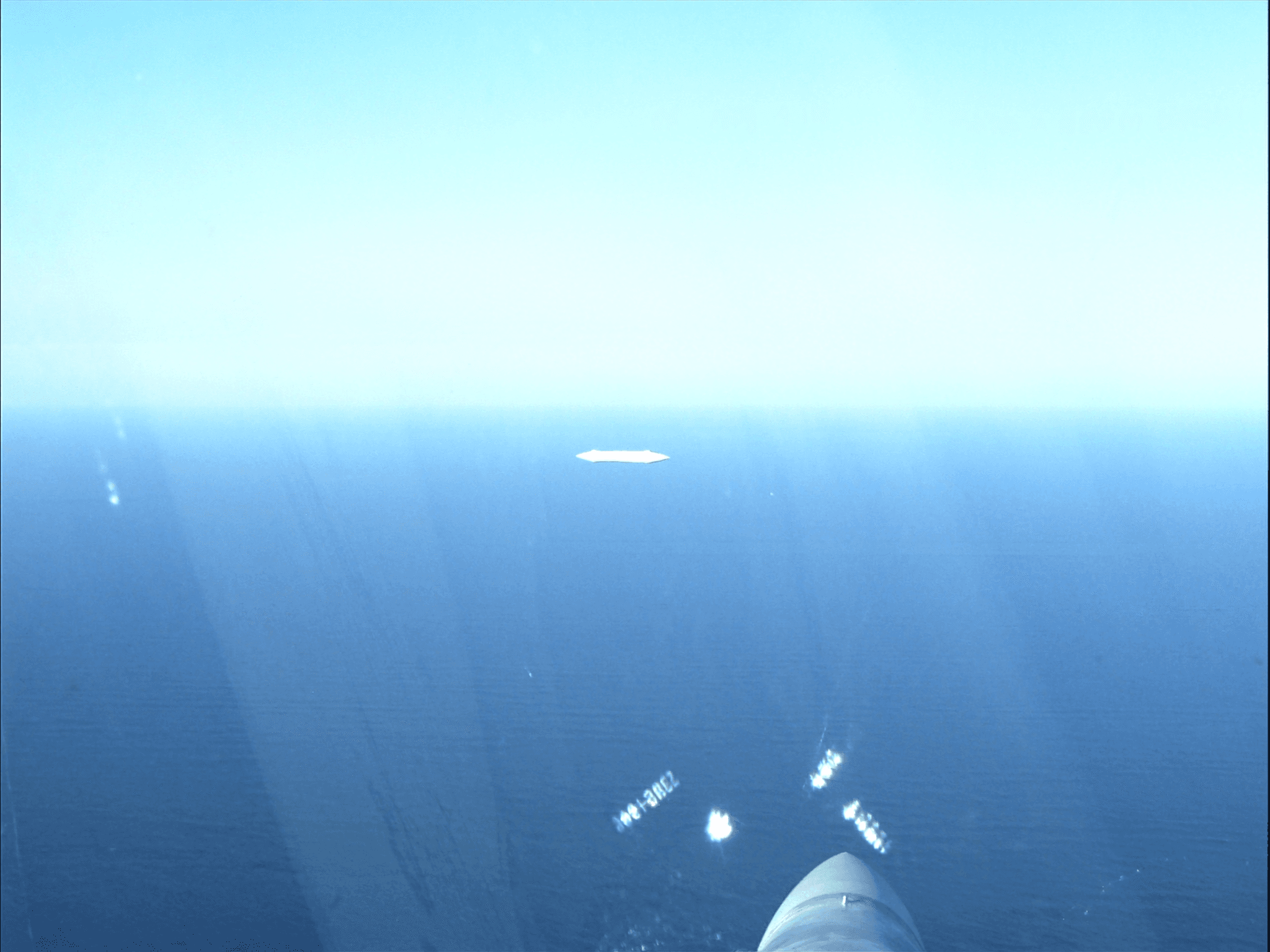
That afternoon, Commander David Fravor and Lieutenant Commander Alex Dietrich, flying two F/A-18Fs on a routine training intercept, were vectored to investigate one of the contacts. They arrived to find an oblong, white, featureless object — roughly 40 feet long, no wings, no exhaust, no obvious propulsion — hovering over a churning patch of ocean. Fravor descended to intercept. The object mirrored his approach, then accelerated horizontally and disappeared from his canopy view within seconds. The Princeton picked it up moments later, sixty nautical miles away, at the CAP point the pilots had been originally vectored to.
Why the data is unusual
Three independent sensor types produced consistent tracks across multiple platforms. The Princeton's SPY-1 radar logged the dive-and-climb profiles. The F/A-18's onboard radar acquired and lost the contact in patterns inconsistent with chaff, electronic countermeasures, or known stealth profiles. An ATFLIR pod on a follow-up F/A-18 recorded the object on infrared — the video the Pentagon eventually released as "FLIR1" in 2017.
Multi-sensor consistency is the test that breaks every easy explanation. Atmospheric anomalies don't appear on radar and FLIR simultaneously with matching geometry. Software glitches don't produce coherent multi-day tracks across independent systems. Hot-air balloons don't accelerate to Mach speeds.
The published explanations don't hold up
Hot-air balloon, atmospheric reflection, radar artifact, secret U.S. drone, foreign reconnaissance asset — each has been debated and each has failed to reconcile the speeds, the multi-sensor consistency, or the maneuvering profile. The most thorough deconstructions come from Fravor himself, who has gone on the record across two decades with the same details. Skeptics have produced no alternative scenario that explains all of the data — only ones that explain some of it.
What this tells us about reporting standards
Fravor and Dietrich filed incident reports through the proper channels. They were ignored, and for a decade, quietly mocked. The 2017 New York Times story changed that, and the establishment of AARO in 2022 institutionalized intake at the Department of Defense level. The lesson the field is still absorbing is structural: a report is only as valuable as the system that receives it.
Sighted's design inherits that instinct. Every report deserves a structured intake — multi-field, time-anchored, geo-anchored, and recoverable — regardless of who filed it or how unusual it sounds. The Nimitz pilots did everything right. The system around them did almost everything wrong.
Why it still matters
The Nimitz case isn't conclusive about origin. It's conclusive about what good UAP data looks like: multi-sensor, pre-recorded, recoverable, and filed quickly. Twenty years later, that bar is still the one to clear.