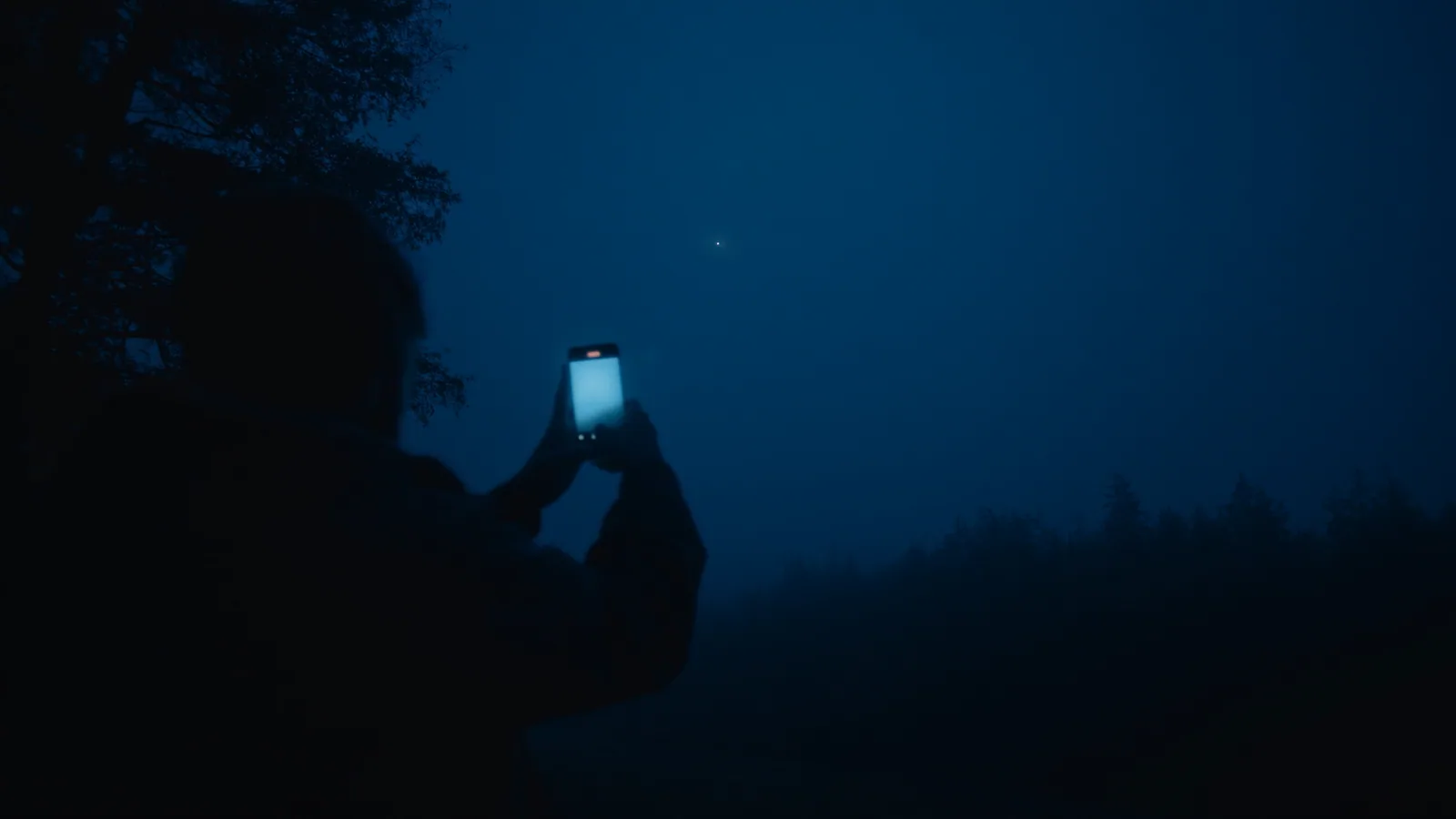
We pull or downvote a small fraction of submitted reports. When we do, it's almost never because the underlying sighting was implausible — it's because the report itself didn't give reviewers anything to work with. Five years of editing these has taught me a short list of things that, done in the moment, dramatically raise the odds your report holds up.
None of this is rocket science. It's the kind of thing you'd want to know before something interesting happens, not after.
Five things to do
1. Timestamp first.
Before anything else — before you text a friend, before you start your phone's video — note the time. Your phone's lock screen will do. Two-minute drift in memory is normal; ten-minute drift across an hour of conversation is also normal. The exact minute matters more than you think because corroborating reports get matched on time windows.
2. Mark the spot.
While you're standing there, drop a pin in Maps or use your camera's GPS-stamped photo. A geotagged photo of the ground next to your feet is enough. Reviewers can reconstruct an awful lot from a precise location; they can do almost nothing with "somewhere near the gas station."
3. Note what you're not sure of.
Investigators trust a report that says "I think it was about the size of a small car at arm's length, but I'm not certain — there was no nearby reference object" far more than a report claiming an exact 12-foot length the reporter couldn't possibly have known. Tagging your uncertainty is the single most credibility-positive thing you can do.
4. Photograph the scene, not just the object.
If you've got time for one photo of the thing, take two: one of the object, and one wider shot showing foreground — trees, a building corner, a horizon, a power line. Reviewers triangulate with those reference points. A perfectly-cropped close-up is almost useless without an anchor.
5. File before you debrief.
Talking to friends or a partner before you write the report down rewrites your memory. There's solid research on this — recall isn't a recording, it's a reconstruction, and the reconstruction gets contaminated quickly. Get the first-pass written down, then go talk about it.
Three things to avoid
1. Don't pad the description.
Phrases like "obviously not from this world" or "definitely not man-made" don't help your report — they bias the reviewer and they bias you. The strongest reports describe what was seen and let the reader form their own view. Write like a journalist, not like an advocate.
2. Don't crop your photos before uploading.
Crop on the page if you want, after the report is filed. Reviewers want EXIF metadata and full-frame context. Cropped images strip both. The auto-cropping some social-share targets do is also a problem — upload the original from your gallery, not from a screenshot.
3. Don't delete the report if you change your mind.
Edit it. The original timestamp matters, and so does the edit history. A report you filed at 21:48 saying "triangle, three lights" and edited at 22:30 to say "actually I think this was a stack of aircraft on approach" is a high-credibility report. A report that disappears is a question mark.
The pattern
The reports that end up at high validation scores follow this rough pattern almost by accident. The reporter was paying attention, wrote it down quickly, included a reference object, and didn't try to convince anybody of anything. They described what they saw. The score did its job from there.
None of this turns an ambiguous sighting into a strong one. But it stops a genuinely interesting sighting from being thrown out because the report didn't survive review. Most of what we do here is preserve information — yours included.