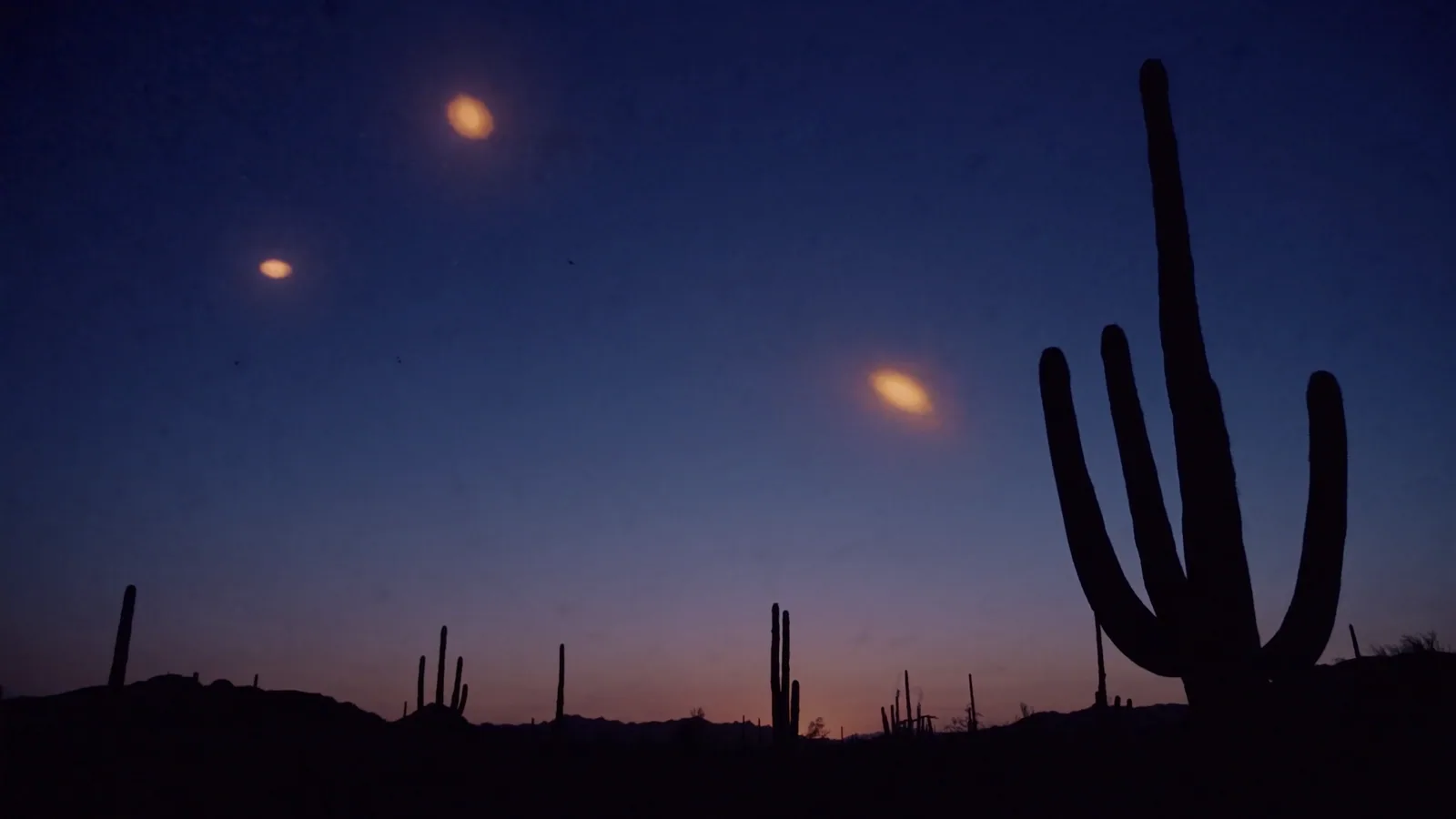
If you sort our archive by region per capita, the Sonoran Desert corridor between Phoenix and Tucson sits near the top of the orb-category leaderboard year after year. Not the most reports total — that title swaps between LA and the Northeast corridor — but the highest density of orb reports per person living in the area. It's a real signal, and like most real signals it's a mix of several things stacked on top of each other.
This post is the version of that analysis I'd give to a journalist who wanted to know whether the Sonoran cluster is "real." The short answer is: yes, mostly, but for at least four reasons.
1. The sky itself
The Sonoran has some of the lowest light-pollution-adjusted clarity in the continental US. The combination of dry air, low humidity, minimal aerosol scatter, and consistently warm overnight temperatures means observers there see fainter objects, at higher contrast, for longer durations than they would almost anywhere else. An object that would be invisible from a Boston suburb is plainly visible from a backyard in Tucson.
So part of the cluster is just: more people seeing more things they could see. The events aren't unique to Arizona — the visibility is.
2. The actual airspace traffic
Southern Arizona is dense with military airspace. Davis-Monthan, Luke, the Goldwater Range, multiple Air National Guard fields, and a thick layer of restricted training corridors. A genuine fraction of orb reports there resolve, on investigator review, to military-adjacent traffic that the witness had no way to identify — flares, ordnance test releases, refuelling formations at unusual altitudes, drones at altitudes drone operators don't normally publicise.
That's not us being dismissive. The fact that something has a military explanation doesn't make the report worthless — it makes the report a useful piece of context for what the public can and can't observe in that corridor. We publish those resolutions instead of quietly closing the case.
3. The local reporting culture
The Phoenix Lights event in 1997 left a durable cultural mark on the region. Anecdotally, residents we've talked to are more willing to file a report than residents of comparable corridors elsewhere. That tracks in the data — for the same per-capita observer base, Arizona's reporting rate runs about 40% higher than the national average.
This is a pure reporting-bias effect, and it's worth being explicit about. The Sonoran isn't producing more sightings per observer. It's producing more reports per sighting.
4. What's left over
After you subtract the visibility advantage, the military traffic, and the reporting-culture bias, there's still a residual. It's not zero. There are case clusters in the Sonoran that we have not been able to map to known traffic, that have multiple independent witnesses, and that recur in the same approximate geographic band over multiple weeks.
The honest version of that statement is: we don't know what's producing those residual clusters. The dishonest version would be either to claim we do, or to claim the residual doesn't exist. Both versions get written about in the comments under every Sonoran post and we ignore both equally.
How to read a Sonoran case
If you're scanning the archive and a Sonoran orb case catches your eye, the things to look at, in order:
- Does the report include a known reference object for altitude? Without one, treat the altitude as unknown.
- What does the investigator note say about military airspace status for that night?
- How many independent witnesses corroborate? Single-witness Sonoran orbs are usually military-explained; multi-witness ones aren't.
- Is the report part of a tight cluster — same week, same band of sky — or a one-off?
The clusters are where the interesting unresolved cases tend to live. The one-offs almost always resolve.
If you're in the Sonoran and you see something worth filing, please file it. The corridor is the most actively-watched region in the dataset and your report is more likely to find a corroborator there than anywhere else.