Witnesses
One witness is a story. Two is a fix.
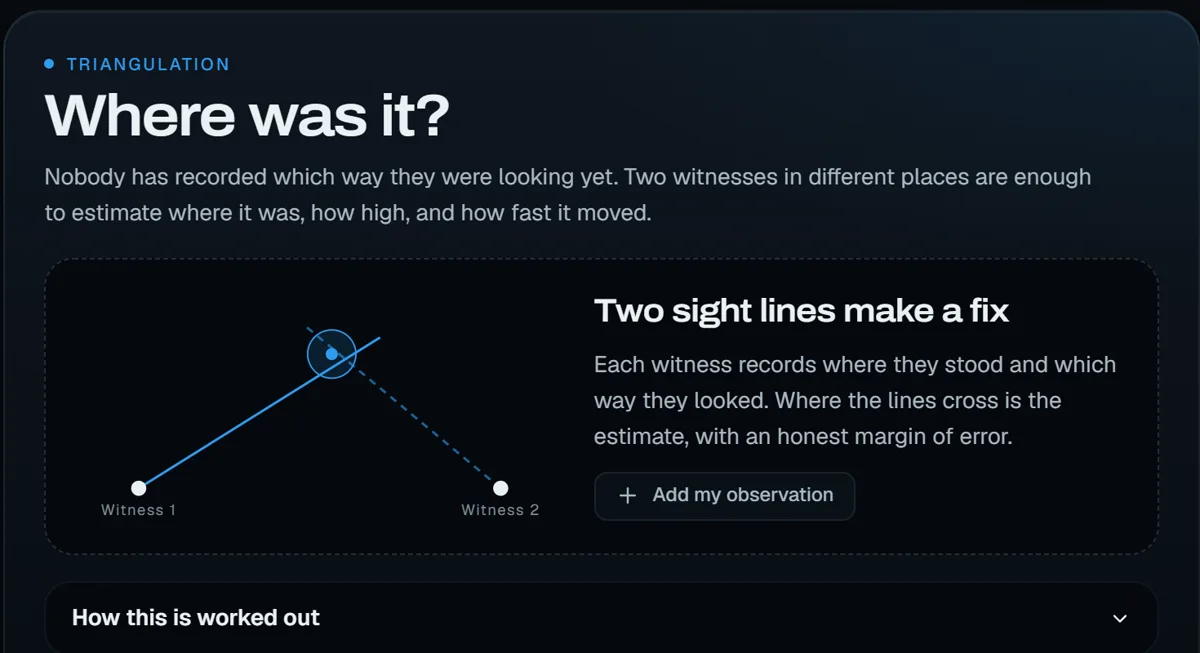
When people in different places record which way they looked, Sighted works out where the object was, how high it flew and how fast it moved, with an honest margin of error.
- Witnesses for a fix
- 2+
- Fix grades
- A–D
- Positions rounded to
- ~1 km
- Witnesses
- 2 independent
- Lines of sight
- Bearing + elevation
- Output
- Position + path estimate
01Add your line of sight
Where you stood. Which way you looked.
Anyone who saw it can add their own sight line to a report: the spot they were standing, the direction they faced, and how sure they are. Followed it across the sky? Add where it ended. On a phone, the report form can use your compass.
- One entry per witness, editable later
- Start and end directions, with your confidence
- Phone compass support when you file a report
02How a fix is made
Lines that cross, graded honestly.
With two or more sight lines from different places, Sighted finds the best-fit position and height where they meet, and grades the result. With end directions too, it traces the path and works out the slowest speed that could explain it.
- Best-fit position and height, with uncertainty
- A path, and a minimum average speed, from start and end directions
- On the 3D globe, a triangulated height raises the report into the sky
Every fix is graded
- AStrong: three or more witnesses, wide crossing angles, bearings that agree
- BGood: lines cross well, with at most one weaker factor
- CRough: a narrow angle, a large margin or bearings that disagree
- DWeak: several factors are poor, and the report says so
One witness gives a direction, not a distance, and the report says exactly that.
03Corroborate
The community weighs the evidence.
Every public report collects votes. A firsthand “I saw it too” counts double; everyone else can mark it plausible or doubtful, and the score is public, along with how it moves.
The validation score
- I saw it tooYou were a firsthand witness+2
- PlausibleIt fits what you know+1
- DoubtfulSomething does not add up−1
Privacy built in
Your evidence counts. Your address doesn’t show.
Triangulation needs where you stood. It never needs to publish it precisely.
- Witness positions
- Rounded ~1 km
- Other witnesses
- Witness A, B…
- Single witness
- Direction only
- Every fix
- Graded A–D
Before anything is shown publicly.
Shown by letter, not by name.
Never presented as a position.
With its uncertainty shown.
Questions
About witnesses and triangulation
I saw the same thing. How do I add myself?
Open the report, choose “Add your line of sight”, mark where you were standing and which way you looked, and how sure you are. If you followed it across the sky, add where it ended too. A free account is all you need.
Is my exact location published?
No. Witness positions are rounded to about a kilometre before they are shown, and other witnesses appear as “Witness A”, “Witness B”, not by name.
What can one witness tell us?
A direction, not a distance. With one line of sight Sighted shows a range estimate and says plainly that a second witness, somewhere else, is what turns it into a position.
How accurate is a fix?
It depends on how far apart the witnesses were and how cleanly their lines cross. Every fix comes with its uncertainty and a grade from A to D, so a rough estimate is never dressed up as a precise one.
What does “I saw it too” do?
It marks you as a firsthand witness, which counts double in the report’s validation score, and lets the reporter know someone else saw it.
Keep exploring
More ways to watch the sky.
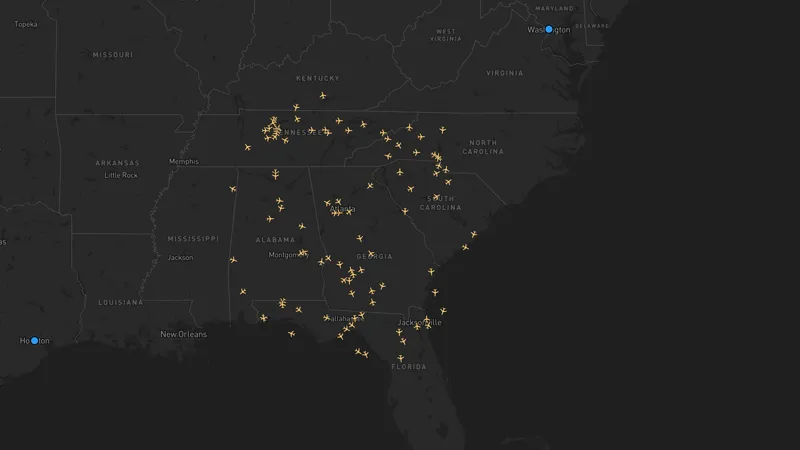 ExploreLive MapEvery public report on one map, with the planes overhead and a timeline back to 1947.
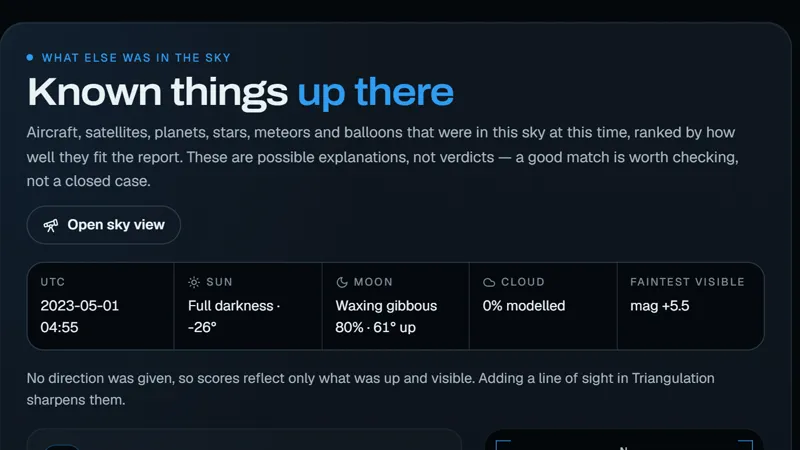 IdentifyIs it Starlink?Every report is checked against the aircraft, satellites and planets in that sky.
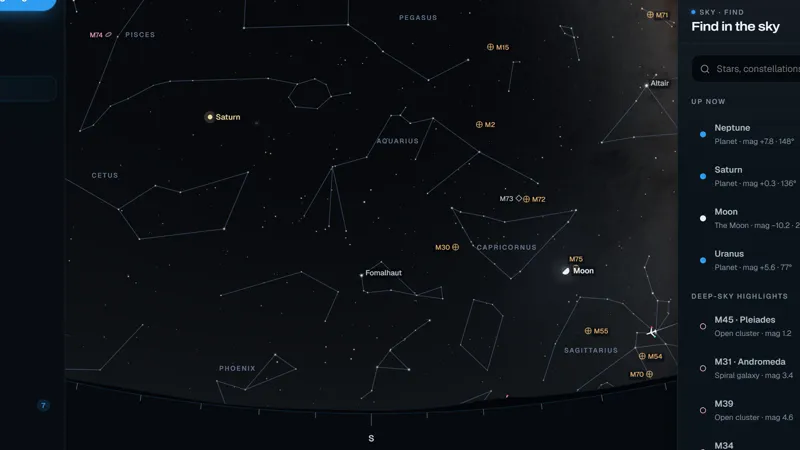 Look upSky TonightThe sky above you right now: stars, planets and what is passing over.
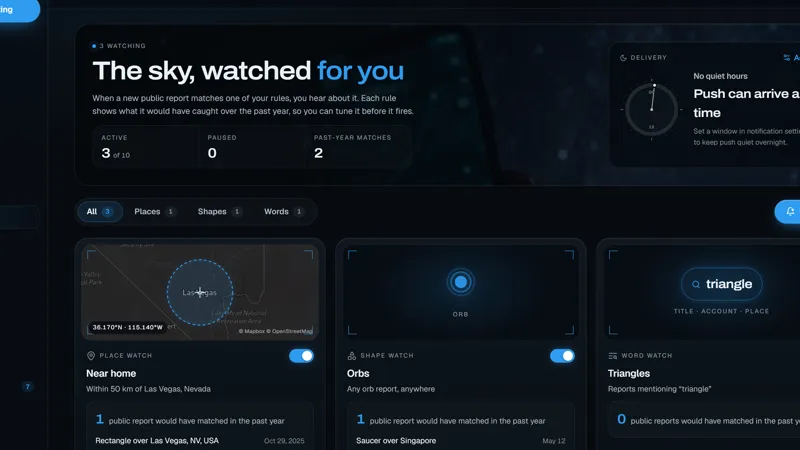 Stay readyAlertsKnow the moment something is reported near you, or the shape you watch for.
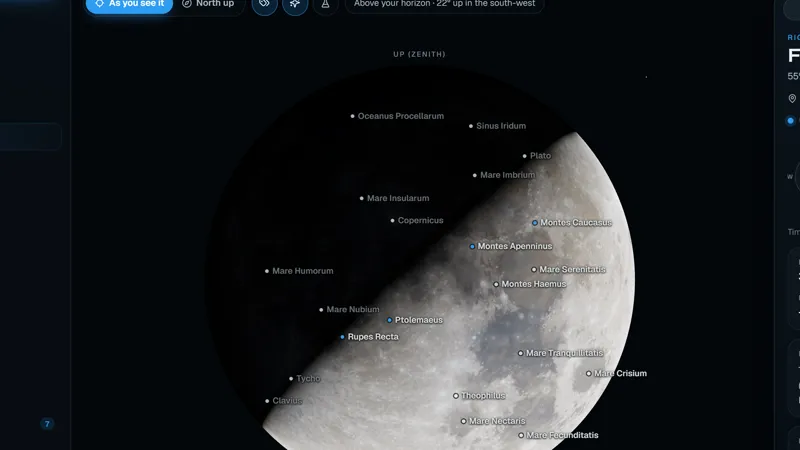 ExploreMoon & PlanetsA 3D Moon and solar system, accurate for any date, so you know what you are looking at.

Did you see it too?